
Protein Molecular Weight Markers

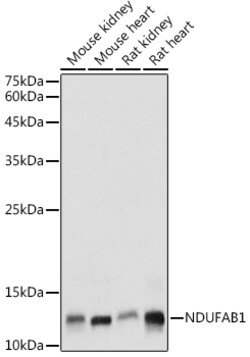
ABclonal Technology NDUFAB1 Rabbit pAb

Predicted to enable acyl binding activity, acyl carrier activity, and fatty acid binding activity. Involved in mitochondrial respiratory chain complex I assembly and protein lipoylation. Located in mitochondrion and nucleoplasm. Part of mitochondrial respiratory chain complex I. Colocalizes with mitochondrial large ribosomal subunit.

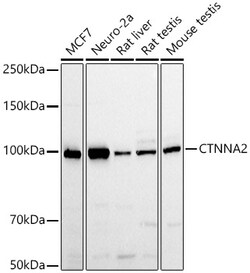
ABclonal Technology CTNNA2 Rabbit pAb
Enables actin filament binding activity. Involved in negative regulation of Arp2/3 complex-mediated actin nucleation, regulation of neuron migration, and regulation of neuron projection development. Located in cytoplasm. Implicated in complex cortical dysplasia with other brain malformations.
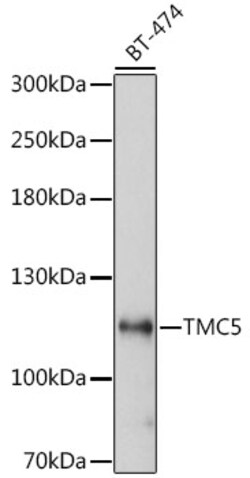
ABclonal Technology TMC5 Rabbit pAb
Predicted to enable mechanosensitive ion channel activity. Predicted to be involved in ion transmembrane transport. Located in extracellular exosome.

S2 Media 15x100mm Chameleon™ COLOREX Salmonella, 10/pack
Chameleon™ COLOREX Salmonella is a selective and differential, chromogenic culture medium used for the qualitative direct detection and presumptive identification of Salmonella. Test specimens include rectal swabs and stools. Concomitant cultures should be performed to recover organisms for further microbiological testing or epidemiological typing. Further identification, susceptibility testing, and epidemiological typing should be performed on suspect colonies. • Product meets CLSI performance criteria.• Chameleon™ COLOREX™ Salmonella should be used by trained professionals within a laboratory setting. • For in vitro diagnostic (IVD) use.• Product is not intended for use in the diagnosis or treatment of disease or other human conditions.

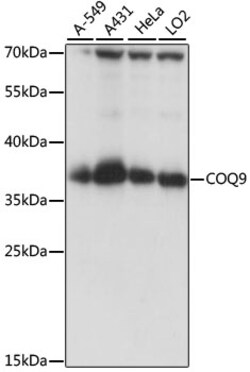
ABclonal Technology COQ9 Rabbit pAb
This locus represents a mitochondrial ubiquinone biosynthesis gene. The encoded protein is likely necessary for biosynthesis of coenzyme Q10, as mutations at this locus have been associated with autosomal-recessive neonatal-onset primary coenzyme Q10 deficiency.
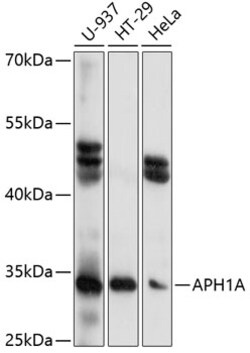
ABclonal Technology APH1A Rabbit pAb
This gene encodes a component of the gamma secretase complex that cleaves integral membrane proteins such as Notch receptors and beta-amyloid precursor protein. The gamma secretase complex contains this gene product, or the paralogous anterior pharynx defective 1 homolog B (APH1B), along with the presenilin, nicastrin, and presenilin enhancer-2 proteins. The precise function of this seven-transmembrane-domain protein is unknown though it is suspected of facilitating the association of nicastrin and presenilin in the gamma secretase complex as well as interacting with substrates of the gamma secretase complex prior to their proteolytic processing. Polymorphisms in a promoter region of this gene have been associated with an increased risk for developing sporadic Alzheimers disease. Alternative splicing results in multiple protein-coding and non-protein-coding transcript variants.
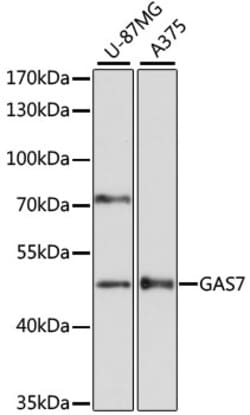
ABclonal Technology GAS7 Rabbit pAb
Growth arrest-specific 7 is expressed primarily in terminally differentiated brain cells and predominantly in mature cerebellar Purkinje neurons. GAS7 plays a putative role in neuronal development. Several transcript variants encoding proteins which vary in the N-terminus have been described.
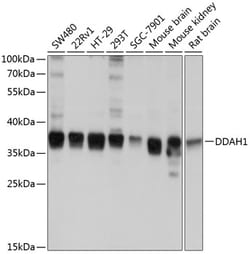
ABclonal Technology DDAH1 Rabbit pAb
This gene belongs to the dimethylarginine dimethylaminohydrolase (DDAH) gene family. The encoded enzyme plays a role in nitric oxide generation by regulating cellular concentrations of methylarginines, which in turn inhibit nitric oxide synthase activity.
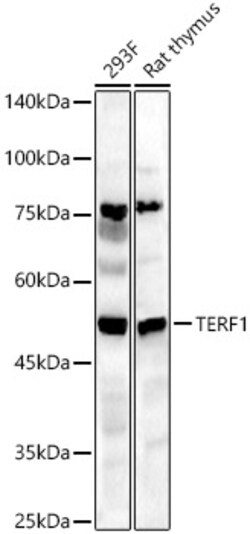
ABclonal Technology TERF1 Rabbit pAb
This gene encodes a telomere specific protein which is a component of the telomere nucleoprotein complex. This protein is present at telomeres throughout the cell cycle and functions as an inhibitor of telomerase, acting in cis to limit the elongation of individual chromosome ends. The protein structure contains a C-terminal Myb motif, a dimerization domain near its N-terminus and an acidic N-terminus. Multiple transcripts of this gene are alternatively spliced products.
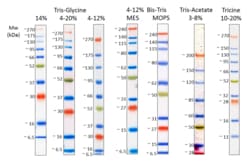
Biolegend Prime-Step™ Prestained Broad Range Protein Ladder
Prime-Step™ Prestained Broad Range Protein Ladder Apps: WB; Size: 50 uL
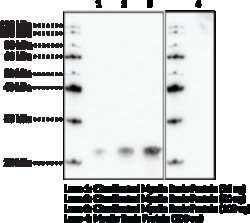
Cayman Chemical CItrulntd Myeln BasIc Pr 500uL
An orally bioavailable broad-spectrum triazole antifungal agent completely inhibits growth of T. rubrum M. audouini M. canis and T. verrucosum as well as some C. albicans and A. fumigatus strains and other fungi (100 g/ml) bacteriostatic against E. coli P. aeruginosa S. aureus and S. pyogenes (100 g/ml) eliminates vaginal C. albicans candidiasis infection in 97 of rats (1 topical) eliminates vaginal C. albicans candidiasis infection in 50 of rats (10 mg/kg oral) decreases synthesis of 14a-desmethyl sterols and increases synthesis of methylated sterols in C. albicans (IC50 3 nM)

STEMCELL Technologies EasySepTM Human CD8 Positive
Large-scale immunomagnetic positive selection of human CD8plus cells (e.g. CD8plus T cells) - 1 x 10.10 cells
Cayman Chemical VItelogenIncod PolycLNal 500uL
Isoprostanesprostaglandin PG-like productsof freeradicalinducedlipidperoxidation.{320 Although the isoprostanes derived from arachidonic acid are the best characterized many other polyunsaturated fatty acids can form isoprostanes.{7323} (±)5-iPF2a-VI is one of dozens of possible stereo- and regioisomeric isoprostanes which can be formed from arachidonic acid. To date the most extensively studied of these is 8-isoprostane (8-epi-PGF2a iPF2a-III).{30645011} However 8-isoprostane is a minor isoprostane constituent when compared to some of the other isomers which form in natural conditions of oxidative stress.{8367} (±)5-iPF2a-VI is an isoprostane from the unique Type VI class of isoprostanes. This class has been shown to be one of the major isoprostane products in contrast to 8-isoprostane. In addition to being produced in greater abundance than 8-isoprostane Type VI isoprostanes form internal lactones which facilitates their extraction purification fro biological samples8367940869106390
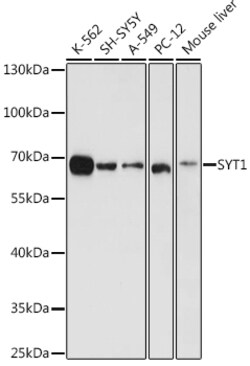
ABclonal Technology SYT1 Rabbit pAb
This gene encodes a member of the synaptotagmin protein family. The synaptotagmins are integral membrane proteins of synaptic vesicles that serve as calcium sensors in the process of vesicular trafficking and exocytosis. The encoded protein participates in triggering neurotransmitter release at the synapse in response to calcium binding. Mutations in this gene are associated with Baker-Gordon syndrome.
Sigma Aldrich Fine Chemicals Biosciences BLUeye Prestained Protein
The ready-to-use BLUeye prestained protein ladder has 12 sharp bands at 11 17 20 25 35 48 63 75 100 135 180 and 245 kDa which has more bands than commonly used markers. The BLUeye prestained protein ladder is provided in a gel loading buffer. A green and a red reference band respectively enable easier identification. The BLUeye prestained protein ladder was produced by GeneDirex Taiwan.